

Ranger is 11 now, a black Lab who weighs about 82 pounds and still thinks he is the same dog who used to meet me at the truck after work. He is not. The back hips are stiff, the mornings are slow, and the two concrete steps off our back porch have become a decision instead of a habit. About a year and a half ago our vet told us Ranger had mild hip arthritis. That is when I started looking at joint supplements, and that is how I ended up buying VETIQ Hip and Joint Chews for Dogs.
I am Gene Whitfield. I am 70, retired after years of coaching high school baseball and teaching history, and I live outside Greenville, South Carolina, with my wife Linda. I am not a veterinarian and I am not selling anything. I am just a man with one aging dog, a Ford F-150, a 20-minute neighborhood loop, and a strong opinion about what is worth keeping in the kitchen cabinet. This is what VETIQ has and has not done for Ranger over the long run.
The Quick Verdict
A chicken-flavored soft chew with 600 mg of glucosamine, fish oil, and krill that Ranger takes without a fight. It did not reverse his arthritis, but over months it became part of a steadier morning routine.
Amazon Check Today's Price →The joint chew that stayed in our cabinet
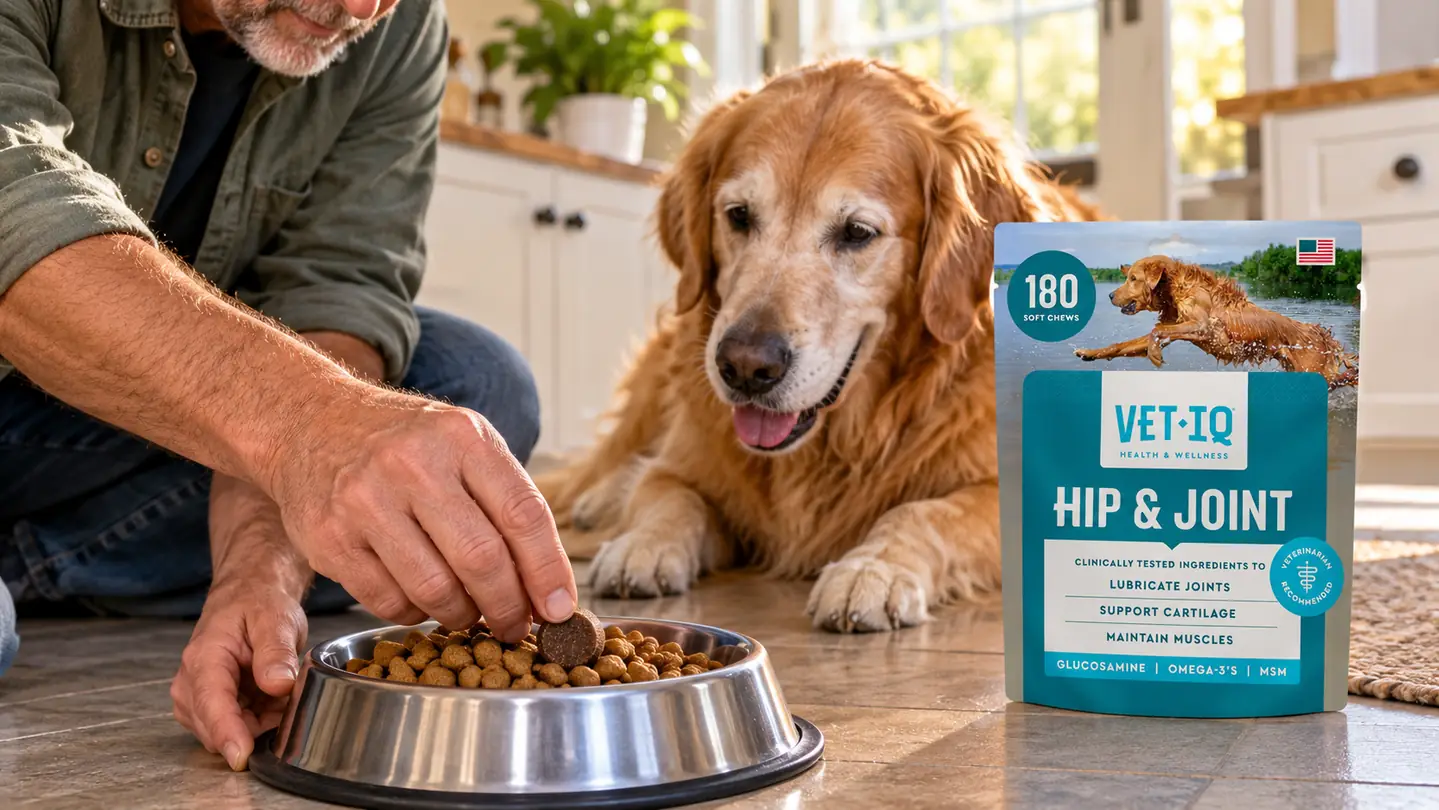
VETIQ Hip and Joint Chews come in a 180 count container, and the label lists 600 mg of glucosamine HCL, 280 mg of fish oil, and 210 mg of krill. Ranger eats them on his kibble.
Amazon Check Today's Price on Amazon →How I've Used It
I started VETIQ after the vet visit, not before. Ranger was 9 when we got the mild hip arthritis diagnosis, and I was told the usual things: keep his weight down, keep him moving, and watch how he does. I asked about a joint supplement. Our vet said a glucosamine-based chew was reasonable to try, and that I should give it time. I followed the directions on the container for his weight and put the chew on top of his morning kibble.
The first container was a 180 count. I liked that because I was not opening a new container every two weeks, and I could keep the routine in one place. The chews are soft, chicken flavored, and Ranger takes them like they are part of breakfast. He is a Labrador, so that is not a high bar, but I have had pills before that he would eat around and leave on the floor. That has not happened with these.
I have now gone through several containers over about 18 months. I did not change his food, his walk route, or his bed. I wanted to know what the chew was doing, not what a dozen other changes were doing. I also kept notes in a small notebook for the first six months, mostly because I am retired and I like a project. I wrote down how he got up in the morning, how he handled the porch steps, and whether he hesitated at the truck.
Linda is the one who keeps me honest about it. She fills the water bowl in the morning while I fix Ranger's breakfast, and she will ask me if I remembered the chew before I have had my coffee. That sounds like a small thing, but a supplement is only as good as the habit around it. If the container sits on the counter and nobody opens it, it does not matter what the label says.
What Is Actually in the Chew
The label is the first thing I check. VETIQ lists glucosamine HCL at 600 mg, fish oil at 280 mg, and krill at 210 mg. The product name also includes MSM. Glucosamine is the ingredient most joint chews are built around, and fish oil and krill are fat sources that show up in a lot of dog joint formulas. The chews are chicken flavored and soft, and the container is listed at 1.4 pounds. The listing also names digestive health and skin and coat health as uses, though I bought them for joint support.
One detail that matters to me: the glucosamine source is listed as shell fish. If your dog has a shellfish allergy, that is not a small note. The chicken flavor is also a real consideration for a dog with poultry sensitivities. I am not a vet, and I am not going to tell you those risks are small or large. I am telling you they are on the label and you should talk to your vet before you buy.
MSM is in the product name, and I know people look for it. I cannot tell you how much is in the chew from memory, and I am not going to make up a number. What I can tell you is that it is part of the formula VETIQ sells, and that Ranger has taken it without any issue. If MSM is the reason you are looking at this product, read the container when it arrives and ask your vet if the amount fits your dog.
The container is 1.4 pounds, and the chews are soft enough to break if I need to, though I give them whole. I keep them in the same cabinet as his food, not in the fridge. The label says chicken flavor, and that is the only flavor I have used. I have not tried a different joint chew during this stretch, so I cannot compare them. I am reviewing this container, this dog, and this routine.
The First Month: What Changed and What Didn't
The first month was not a light switch. Ranger still got up slow. He still paused at the porch steps. If I am honest, I was looking for a reason to stop buying the chews, because I have tried other supplements that did nothing but take up space and make me feel foolish. Around week three I thought I saw him rise a little easier after a nap in the den, but I could have been seeing what I wanted to see. That is why I kept the notebook.
By the end of the first container, the change was small and real. He was not trotting. He was not jumping. He was getting to his feet with less of that first hard pause, the one where his back end seems to need a second to catch up with the rest of him. That is the kind of thing you notice in a house with one dog, because you see the same 10 feet of hallway every day.
I also watched for the things that would make me stop. Loose stool, vomiting, itchiness, a dog who turns his nose up. None of that happened. That does not mean it cannot happen to your dog. It means it did not happen to mine. I kept him on the same food and the same treats, so if something had gone wrong I would have known where to look. That is just how I like to test things.
The Truck, the Porch Steps, and the 20-Minute Loop
The truck was the clearest test. Ranger used to come to the F-150 and stand there, looking at the floorboard like it had moved. He would put one front paw up, then take it back. After several months on VETIQ, he still does not launch himself in. He does climb in with less circling. That is the honest version. If you are looking for a dog who starts leaping into a pickup again, I cannot promise you that, and I do not think a chew can promise it either.
The porch steps are two concrete steps down to the fenced yard. For a while he would stop at the top and look at them. Now he takes them one at a time, and he does not stand there as long. Linda says she can tell by the sound of his nails on the concrete. I think she is right. The walk is still about 20 minutes around the neighborhood loop, and he still lags on the way back. He finishes it, though. That is the bar at 11 years old.
I want to be careful here. This is not a pain pill. Ranger is still an old Lab with arthritis. On damp mornings he is stiff. After a long nap on the carpet in the den he needs a minute. VETIQ did not make him a puppy, and I would not trust a review that said it did. What it did was make the ordinary parts of his day a little smoother, and for an 11-year-old dog, that is worth something.
There is a temptation to overread the good days. A dog has a good morning and you think the chew is working. A dog has a bad afternoon and you think it is not. I tried to look at the whole month, not the single day. When I did that, the pattern was slow and modest. Fewer long pauses. Less circling before the truck. A little more willingness to go down the steps to the yard. That is the kind of evidence I trust.

The Tradeoffs I Noticed
The biggest tradeoff is time. You do not see anything in a week. If you are the kind of person who wants proof by Friday, you will be disappointed. I also do not love that the container is large. It takes up shelf space in the kitchen, and I have to keep it sealed and cool. That is a small thing, but it is a thing. And you have to remember it every day. A supplement only works if it gets into the dog.
Ranger has had no stomach upset from VETIQ that I could see. His appetite is the same, and his coat looks the same to me. The listing mentions skin and coat and digestive support, but I did not buy it for those and I cannot say I noticed a change there. I also cannot tell you which ingredient is doing the work. It could be the glucosamine, the fish oil, the krill, the MSM, or the simple fact that I am paying more attention to how he moves. I am fine not knowing. I am not fine pretending I do.
I also wish the label were easier to read on the container. That is a small complaint from a man who wears reading glasses in the kitchen, but it is true. I have to hold it under the light to check the amounts. If you are splitting the job with a spouse or a dog sitter, make sure they know the directions and the amount for your dog. Two people guessing is worse than one person reading.
What I Liked
- Ranger takes the chicken flavor without a fight
- Soft chew goes on kibble easily
- Label lists 600 mg glucosamine HCL, 280 mg fish oil, and 210 mg krill
- 180 count container cuts down on reordering
- No stomach upset or appetite change for Ranger
- Over months, less hesitation at the porch steps and truck
Where It Falls Short
- Not a pain medication
- Takes weeks to judge
- Large container takes shelf space
- Shell fish and chicken are allergy concerns
- Does not reverse arthritis or bring back his puppy energy
- Still stiff after long naps and on damp mornings
The change I trust is not a number in a notebook. It is Ranger standing at the back door, looking at the two concrete steps, and taking them without that long pause.
Who This Is For
If you have a senior dog who is stiff in the back end, still eats well, and is not in obvious pain, VETIQ is a reasonable thing to talk to your vet about. It fits a dog who will take a soft chew and a person who can keep a daily routine. It also fits a household that wants a 180 count container so the routine does not depend on reordering every few weeks. Ranger is 82 pounds and 11 years old, and this is the chew that has stayed in our cabinet.
This is also for the owner who is not ready to jump to a prescription or a stronger drug, but wants to do something sensible in the meantime. That was me. I wanted a daily chew I could put on his food, not a new routine that took over the morning. VETIQ fit that. It did not ask me to change his food or add a second walk. It asked me to be consistent, and that I can do.
Who Should Skip It
Skip it if your dog has a shellfish or chicken allergy, or if you have not checked with your vet about the ingredients. Skip it if you want a pain pill or a quick fix. Skip it if you cannot be consistent, because a chew every now and then is not a fair test. And skip it if your dog is showing sudden weakness, dragging a leg, or refusing to eat. That is a vet visit, not a supplement decision. I say that as a coach, not a doctor.
If your old dog is hesitating at the steps, start with a vet talk and a plan
VETIQ Hip and Joint Chews are the chicken-flavored soft chews I have used with Ranger. Check the label, check with your vet, and give it time.
Amazon Check Today's Price on Amazon →