

Ranger turned eleven this spring. He is a black Lab, about eighty-two pounds, and our vet found mild hip arthritis in him when he was nine. What I noticed first was not a limp. It was a pause. He would get to the two concrete steps off the back porch, stop, and think it over. If you have an older dog, you have seen that pause. That is how I ended up standing in the kitchen reading the label on a bottle of Cosequin from Nutramax Laboratories, and it is why I want to lay out ten plain reasons glucosamine and chondroitin matter for a dog like mine.
I am a retired baseball coach, not a veterinarian, and I am not going to promise you anything about your dog's hips. What I can do is tell you what is in the bottle, why each piece is in there, and what to ask before you spend a thing. Talk to your vet first. Then read the rest of this.
The bottle our vet did not squint at
Cosequin from Nutramax Laboratories puts 600 mg of glucosamine hydrochloride and 300 mg of sodium chondroitin sulfate in each chewable tablet, plus MSM and hyaluronic acid. One bottle on the counter instead of three.
Amazon Check Today's Price on Amazon →Cartilage in an old dog wears down faster than it rebuilds
Cartilage does not get a blood supply the way muscle does. It takes what it needs from the fluid moving around the joint, which means it is slow to repair and quick to wear. In a young dog those two sides balance out. In an eleven-year-old Lab with eighty-two pounds riding on two hips, the wear side wins. That is the whole reason a supplement enters the conversation. You are not rebuilding a joint. You are trying to tip a scale that has been sliding the wrong way for a couple of years now.
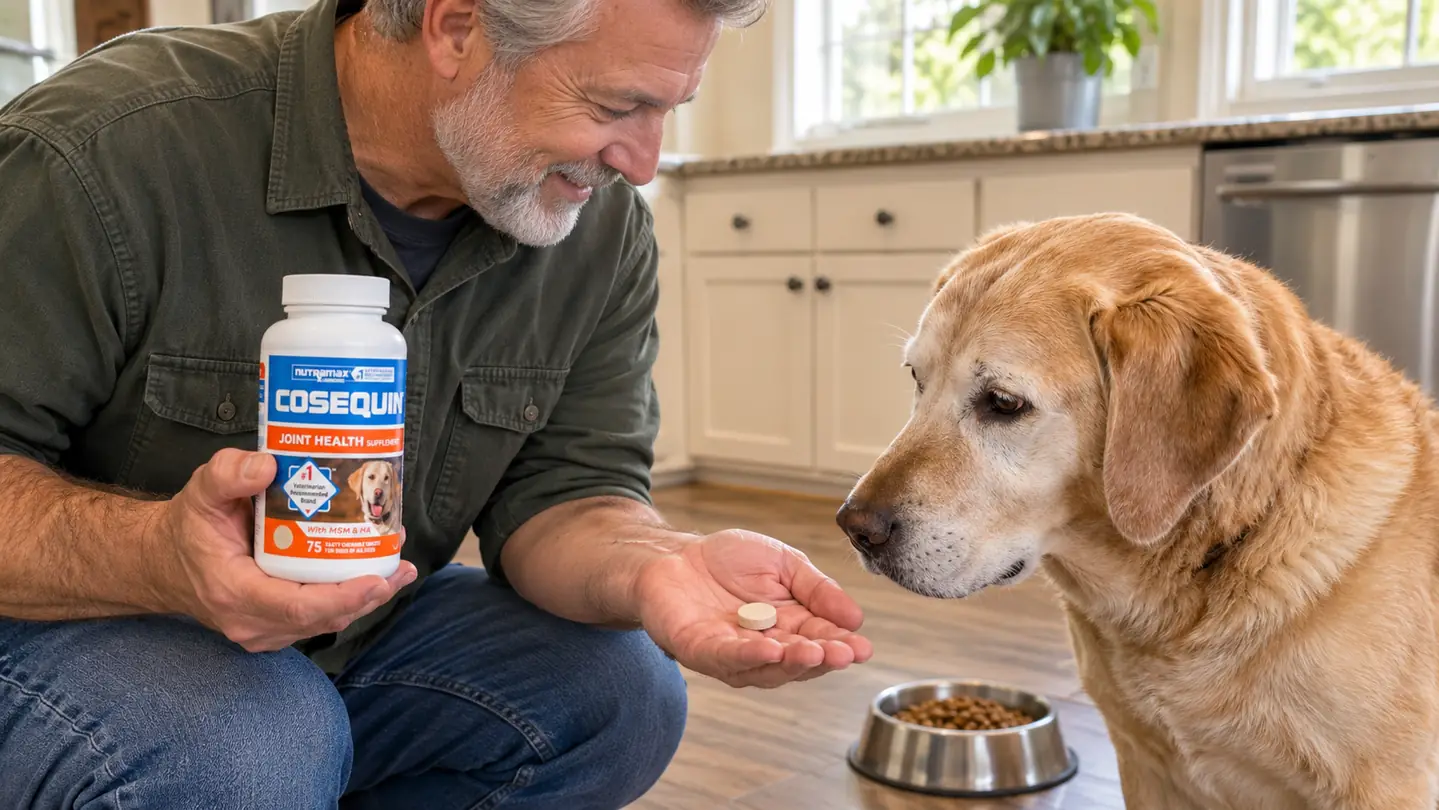
Glucosamine is the raw material, and this label gives you 600 mg
Glucosamine is what the body uses to make the compounds that give cartilage its cushion. Cosequin puts 600 mg of glucosamine hydrochloride in every tablet. That number matters to me because plenty of products list glucosamine in a blend and never tell you how much is actually in there. You want a figure, not a word. When I called our vet's office to ask about starting Ranger on it, the first thing the tech asked was the milligrams per tablet. I read her 600 and she said that is a real dose for his size, and we would go from there.
Chondroitin at 300 mg is a partner ingredient, not filler
Sodium chondroitin sulfate shows up at 300 mg per tablet in this formula. Chondroitin is the one that gets paired with glucosamine in just about every study and every vet conversation I have sat through. Whether you think the research is mixed or settled, the practical point is simple. If you are going to give one, give the pair, because the dosing advice is built around the combination. A bottle with glucosamine alone is a different conversation from the one your vet is probably having with you.
MSM means one bottle on the counter instead of three
MSM is in this formula too, and I will admit I did not know what it was two years ago. What I know now is practical. It saved me from stacking three bottles, three doses, and trying to remember which came first. Linda has a small kitchen and she was not giving up counter space to a supplement shelf. One bottle, one tablet, one time of day. That is worth more than it sounds when you are seventy and the dog is standing at the door giving you a look.
Hyaluronic acid is in the same tablet, so you do not buy it twice
Hyaluronic acid is part of this formula, and it is the ingredient I would have had to buy separately otherwise. It is the piece that helps joint fluid do its job. I am not going to sit here and tell you I can watch it working. What I can tell you is that a formula with four ingredients in one tablet is one I will still be using in month four, and the one I have to assemble from three bottles is the one that ends up in the back of the pantry behind the cornmeal.
Six hundred milligrams of glucosamine hydrochloride per tablet. That is a number I can read to the vet's office over the phone without translating anything.

Vets reach for this brand first, and that saves you a phone call
Nutramax Laboratories has been at this for over twenty-five years, and Cosequin is described as the number one vet recommended retail joint health supplement brand. I care about that less as a badge and more as a shortcut. When I told our vet what I had picked up, she did not wince. She nodded and said that is the one most of her clients use. If you have ever carried an unfamiliar bottle into an exam room and watched the vet read the label with a squint, you know what that nod is worth.
The label gives you numbers you can repeat to your vet
Six hundred milligrams of glucosamine hydrochloride. Three hundred of sodium chondroitin sulfate. MSM. Hyaluronic acid. Tablet form. That is a label you can read over the phone without translating a thing. Half the trouble with supplements is that nobody can tell the vet what they are actually giving. If your dog has kidney trouble, or is on another medication, or has a dental coming up, those numbers are the whole conversation. Write them on the bottle cap if you have to. Just have them.
A chewable tablet goes down without a fight
Ranger is a Labrador, which means he has never once declined something that might be food, so I am spoiled. But I have watched friends wrestle with powders and liquids and dogs who spit pills onto the floor. This is a chewable tablet. It goes in the bowl with the kibble, or it goes in your hand and disappears. On the road it goes in a sandwich bag in the console of the truck. No scoop, no shaking a tub in the wind at a rest stop, no measuring.
A bottle of 75 builds a routine you will actually keep
Seventy-five chewable tablets. Whatever your vet sets for your dog's weight, you will go through them at a pace you can predict. That means you can see the end of the bottle coming and order before you run out. Sounds small. It is not. The dogs that do well on joint supplements are almost never the ones with heroic owners. They are the ones whose owners kept a boring routine going for two years because the bottle sat where they could see it.
It gives you something to measure instead of a feeling
Here is what I did with Ranger, and I would do it again. I wrote down one thing: whether he took the porch steps in one motion or stopped at the top. One line a day in a notebook by the coffee maker. Six weeks in, I had a record instead of an impression. Whatever you use, use something you can compare month to month, because memory is a liar and he seems about the same is not a data point your vet can work with.
What I'd Skip
I would skip anything that hides its ingredients behind a proprietary blend. If the label will not tell you how many milligrams of glucosamine are in a tablet, it is not telling you because the number is small. I would skip the bottles with eleven ingredients at doses too low to matter, and the ones that promise to rebuild a joint. Nothing rebuilds a joint. What you are doing is supporting the cartilage that is left and slowing the slide. And I would skip the impulse grab at the feed store checkout counter. Read the label first, then decide.
The other thing I would skip is the notion that a supplement replaces the vet visit. Ranger still goes in twice a year. Our vet still puts her hands on his hips and watches him walk away from her down the hall. A bottle from Nutramax Laboratories is a piece of the plan, not the plan. Talk to your vet before you start or change anything, especially if your dog is on another medication or has kidney issues. That is not a disclaimer. That is how you keep a good dog comfortable for longer.
Ten reasons, one bottle, and a vet who nods instead of squints
Cosequin chewable tablets from Nutramax Laboratories: 600 mg glucosamine hydrochloride, 300 mg sodium chondroitin sulfate, plus MSM and hyaluronic acid. Ask your vet about the right amount for your dog's weight, then keep it boring and keep it going.
Amazon Check Today's Price on Amazon →