
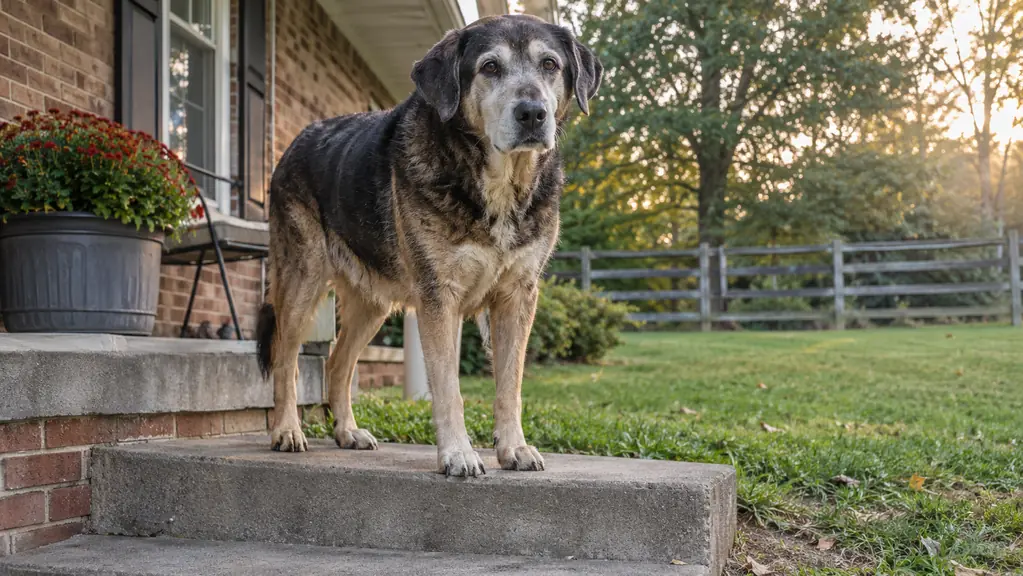
Ranger turned eleven this spring, and the two concrete steps off our back porch have started to look like a flight of stairs to him. He stops at the top, thinks it over, and comes down one step at a time with his back end swinging wide to the right. I am seventy years old, I have a bad knee of my own, and for a while there my entire plan for getting him up those steps was a towel looped under his belly and a fair amount of hope. That plan works about as well as you would guess. Then I ordered the PICK FOR LIFE lift harness in X-Large, and I have used it on Ranger nearly every day since. Here is what six months of that actually looks like.
One thing before we go further. This is not a medical opinion and I am not a veterinarian. Ranger was diagnosed with mild hip arthritis when he was nine, and everything about his care runs through our vet, including what he eats and how far he walks. A sling carries weight. It does not fix a joint, and it will not make an old dog young again. What it does is let me do the daily lifting without wrecking my own back, which was the real problem in this house. If your dog is slowing down, get the diagnosis first. Then worry about equipment.
The Quick Verdict
A plain nylon sling with padded handles that lets me take Ranger's back end weight off his hips on the porch steps and at the truck. It has survived daily use and repeated washing. It also has real limits, and the first one is fit.
Amazon Check Today's Price →Two Steps Should Not Be the Hardest Part of the Day
This is the X-Large adjustable lift harness I put on Ranger every morning before he comes down the porch. Check the size chart against your dog's girth and see today's price on Amazon.
Amazon Check Today's Price on Amazon →How I've Used It
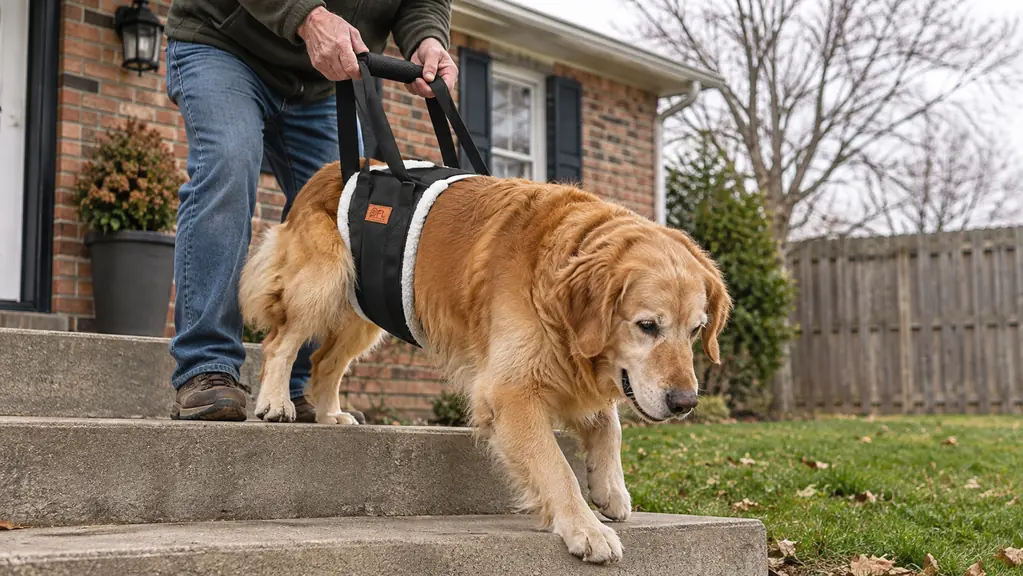
Our routine is boring, and that is the point. Ranger goes out the back door onto the porch. I stand on the top step with the sling under his hindquarters, both hands on the padded handles, and take maybe a third of his weight while he walks down. Same thing coming back up. He runs about eighty-two pounds, and at his stiffest in the mornings he is not going to manage that transition on his own without a stumble that scares us both. The whole thing takes about twenty seconds, which is twenty seconds less than the towel ever took. Before the sling I tried a bath towel folded lengthwise, then a canvas tote bag with the handles cut down, and both of them ended the same way. The load slid forward, Ranger sat down hard on the middle step, and I had to start over. Linda timed the towel once in February. Four minutes and a fair amount of language I will not repeat here.
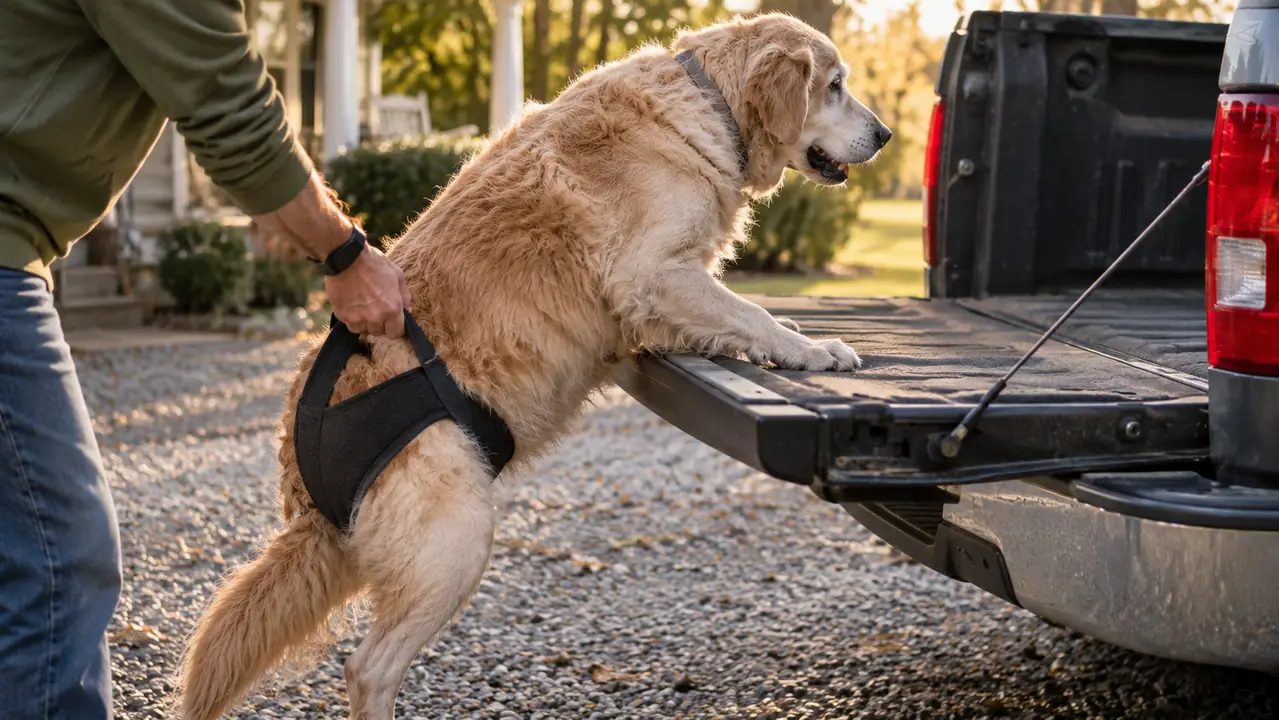
The truck is the other place it earns its keep. Ranger used to launch himself into the F-150 without a second thought. Around age nine he started hesitating at the tailgate, and then he quit trying altogether. Now I set the sling under him, lift with my legs, and he steps up with a hand steadying his back end. It takes both of my hands, so there is nobody free to hold the coffee, but it takes fifteen seconds instead of a five minute negotiation that ended with both of us frustrated.
The twenty minute loop around the neighborhood is where I do not use it. On flat pavement Ranger gets along fine, and I would rather he keeps doing that work himself. My rule of thumb, and our vet did not argue with it: use the sling where the dog is genuinely struggling, not everywhere, so the muscle he still has stays in the job. A dog that gets carried everywhere gets weaker, and I have watched that happen to people, never mind dogs.
The first week was clumsy. I had it too far forward and it rode up under his belly, and once I set it too far back and it slid while he was stepping down. By the end of that week I had a spot that worked and my hands knew where to find it without me looking. Total, I would guess I have put this thing on and taken it off well over a thousand times by now. That is the only kind of testing that tells you anything about a piece of nylon and some stitching.
What This Harness Actually Is
Strip away the marketing language and it is a sling that goes under the dog's rear legs and belly, with two padded handles on top so a person can carry part of the load. The listing describes it as a rear leg support harness for elderly, disabled or injured dogs, and that is exactly what it is. The material is nylon. It weighs 14.08 ounces, so it folds up and lives in the door pocket of the truck without anybody noticing it is there.
The part that matters for a big dog is sizing. This is the X-Large, sold for large to extra large dogs, with an adjustable length strap. The listing gives that adjustable length as 52 to 76 without naming the unit, so do not guess off that number. Get the tape measure out and check the size chart against your dog's girth before you order. I measured Ranger twice, and the second measurement was the correct one. The first time I ran the tape around his chest instead of his girth because I was in a hurry, and the number I wrote down was four inches off what the chart wanted. The second time I had Linda hold him steady on the kitchen vinyl and I took it slow, right around the widest part behind his front legs. That number put us squarely in the X-Large, and it has fit ever since. That is on me for rushing, not on them.
Two details I did not expect to care about. First, the handles are padded, which sounds like a small thing until you are holding a third of an eighty-two pound dog's weight for the tenth time before breakfast. Second, it is machine washable. Something that sits under a dog's hindquarters for months gets ripe, and being able to throw it in the wash is not a luxury, it is a requirement. The closure is a drawstring, so you set it once and leave it.
What It Changed Around Here
The change that mattered most was not Ranger's. It was mine. For about a year before I bought this, I was lifting him wrong. I would get an arm under his belly and haul, and my lower back would complain for two days afterward. A retired coach with a bad knee does not need a back problem on top of it. With the handles I lift with my legs and the load is shared, and I finish the morning without paying for it later in the afternoon. I noticed the difference in my own back about ten days in, well before I noticed anything at all about Ranger's hips. That surprised me.
The second change is confidence. An old dog that has fallen once gets careful, and a careful dog stops asking to go out. Ranger had started skipping the porch entirely some evenings, which meant skipping the yard, which meant a whole set of other problems. He does not skip it now. Whether that is the sling or simply that he is not getting jerked around anymore, I could not tell you. I know which one I can control.
Linda noticed it before I did. She said he had stopped standing at the top of the steps doing arithmetic. That is her word for it, and it is a better description than anything I have come up with. He used to look down at those two steps like he was figuring a tip. Now he just goes, because he knows a hand is going to be there.
Six Months In
This is where most reviews stop being useful, so here is the honest wear report. The stitching at the handle attachment points is intact. The nylon has not frayed at the edges where it rubs under the leg. There is a slight softening in the padding, the way a good work glove softens, but nothing has flattened out or torn through. The drawstring closure still holds right where I set it back in the spring.
It has been through the washing machine more times than I can count, on whatever cycle Linda runs, then hung over the porch rail to dry. It has come out the same shape every time. No shrinking, no bunching, and nothing to rust, because there is no metal anywhere on it. For a piece of gear that costs less than a decent pair of boots, that is a fair run. The label inside is faded to nothing now, and there is a worn spot on one handle where the padding has taken the shape of my right hand. I do not count that as a defect. I count it as six months of mornings. If I were buying again I would buy the same PICK FOR LIFE sling, and I would still check the stitching in week one instead of trusting the listing photo.
One thing I will flag plainly. The warranty description on the listing is seven days. Read that again. Whatever confidence the manufacturer has in this, it is not backed by a long warranty, so treat the first week as your testing window. Fit it, use it on the steps and at the truck, check the stitching yourself, and if it is wrong for your dog, deal with it fast rather than in month three.
Where It Falls Short
Fit is the whole ballgame, and it is where the complaints come from. A sling that sits too far forward or too far back will ride up or slide, and on a dog shaped differently from Ranger it may not stay put at all. There is no shaping to it. It is a strap and a sling, and it depends on you placing it correctly every single time. If you want something that clicks on and forgets itself, this is not that thing.
It is also a rear-end tool and nothing more. Ranger's front end is fine, but if your dog's weakness is in the shoulders or the front legs, this does nothing for you. And it is not a walking harness. I would not leave it on for a neighborhood loop, because a sling hanging under a moving dog is a snag waiting to happen on a bush or a porch rail. I found that out the hard way in July, when I left it on for the loop and the loose strap caught the end of the porch rail coming back up the steps. Nothing broke and nobody got hurt, but Ranger turned around and looked at me like I had lost my mind, and he was not wrong.
Last, the honest one. It is still work. The harness does not lift the dog. You lift the dog. All this does is give you handles and spread the load so you can do it without hurting yourself. Somebody who cannot safely take thirty or forty pounds of a dog's weight is not going to be rescued by a strap, and I would rather say that out loud than sell you something that will not do the job you need. That is the same thing I would tell you about any PICK FOR LIFE product, and it is why I am specific about what this one does and does not do.
What I Liked
- Padded handles let me carry a big dog's back-end weight without wrecking my own back
- Nylon construction and stitching held up through six months of daily use and repeated washing
- Machine washable, which matters for something that lives under a dog
- Adjustable strap and an X-Large size that genuinely fits a large dog
- Light enough at 14.08 ounces to keep in the truck door pocket
Where It Falls Short
- Fit is everything and there is no shaping, so it will slide if you place it wrong
- Rear leg support only, no help at all for the front end
- Warranty is described as seven days, so test it in the first week
- It carries weight, it does not do the lifting for you
The harness does not lift the dog. You lift the dog. What it gives you is handles and a share of the load, and on a stiff morning that is the difference between going out and staying in.
Who This Is For
This is for the owner of a large or extra large dog whose back end is the problem. Weak rear legs, a dog recovering from a rear leg injury, a dog on crate rest after surgery, a dog that needs a hand on the steps, into the truck, or up onto the couch. It is for someone who can physically take part of a big dog's weight and wants to do it without their own back paying the bill. If that is your situation, the PICK FOR LIFE sling is a plain tool that does the plain job, and it has done it here every morning since spring.
Who Should Skip It
Skip it if the weakness is in the front legs, the shoulders or the neck, because this will not touch that. Skip it if you cannot safely take thirty or forty pounds of a dog's weight, because a strap does not change that arithmetic. Skip it if you want a hands-free walking harness, since this is not one. And skip the impulse buy. Measure the dog, check the size chart, and talk to your vet about how much weight you should be supporting and where, because supporting a dog in the wrong spot is worse than not supporting him at all.
Measure the Dog First, Then Order the Right Size
X-Large, adjustable strap, padded handles, 14.08 ounces. Take the tape measure to your dog's girth, check the size chart, then see today's price on Amazon.
Amazon Check Today's Price on Amazon →