
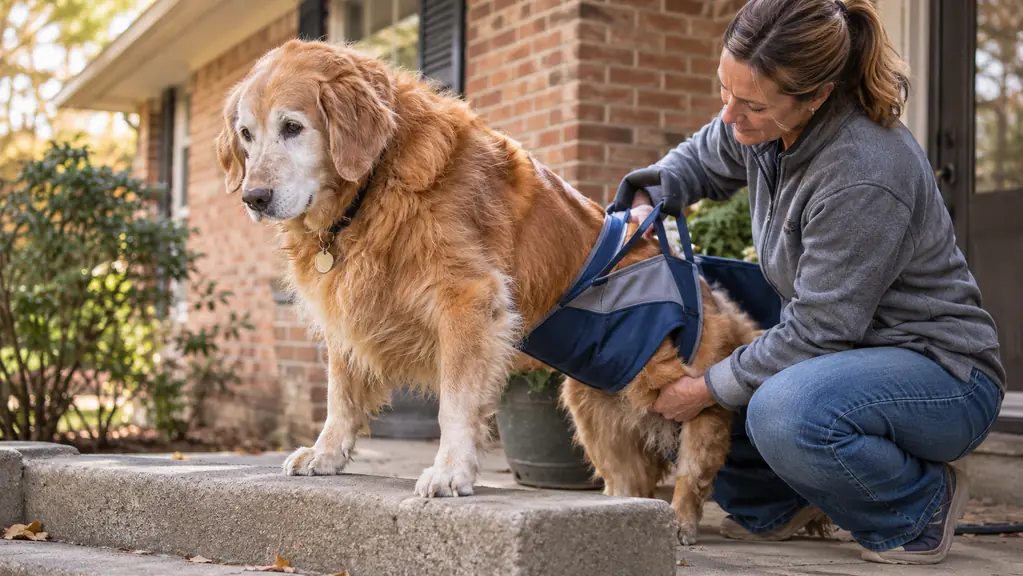
Short answer first, the way I would give it on the porch. If your dog is stiff in the back end and needs a hand up the steps, into the truck, or off the kitchen floor, the PICK FOR LIFE lift harness is the one I reach for. It goes on in seconds, the handles are padded where my hands actually land, and for the two concrete steps down from my back porch it does the whole job. The Help Em Up harness is a different tool. It wraps the entire dog and gives you a lift point at the chest as well as the hips. If your dog needs that, no rear sling is going to replace it.
I am seventy, retired, and I have one dog. Ranger is an eleven-year-old black Lab, about eighty-two pounds, and our vet found mild hip arthritis in him at nine. He is not a wreck. He is slow in the morning, slow after a long nap, and he stands at the top of those porch steps and thinks about it now before he comes down. That thinking is what sent me shopping. Here is how the two harnesses differ, where each one honestly beats the other, and which one fits a dog like mine.
| PICK FOR LIFE | Help Em Up | |
|---|---|---|
| Where it supports | Rear legs and hindquarters, a sling that passes under the back end | Chest and hindquarters, with lift points at both ends |
| Putting it on | One adjustable strap with a drawstring closure, on in a few seconds | Shoulder straps plus clips front and rear, more steps to learn |
| Handles | Padded handles at the rear lift point | Padded handles front and rear |
| Cost | Less expensive | More expensive |
| Material and care | Nylon, machine washable | Fleece lined, machine washable |
| Sizing | Large to extra large, with an adjustable length strap | Multiple sizes fitted by girth and weight |
| Wearing it all day | Built for lifts: steps, the truck, the vet, short walks | Designed to stay on the dog through the day |
| Best for | A dog who is weak in the back end only | A dog who needs help front and back |
Where PICK FOR LIFE Wins
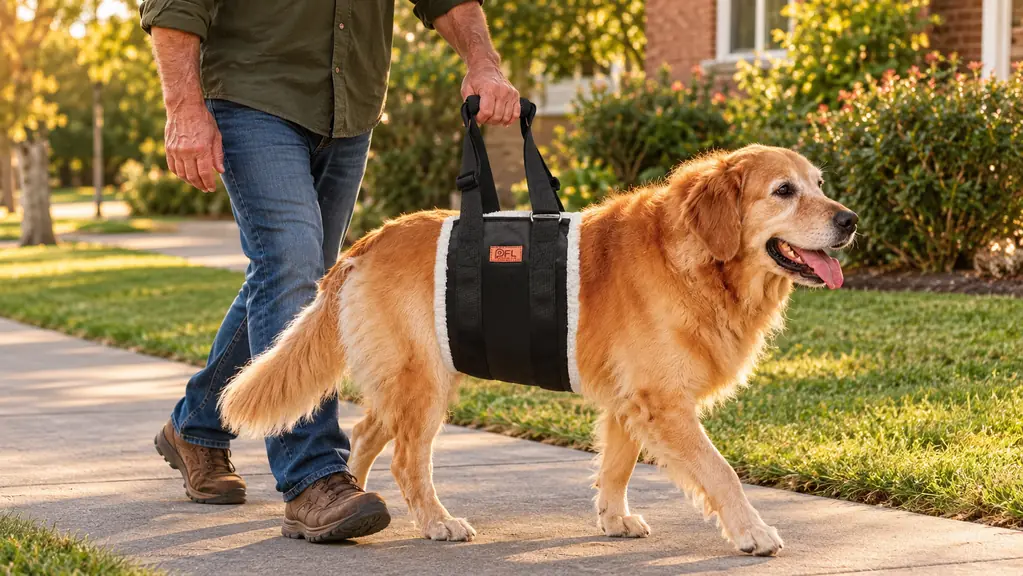
Putting it on is the first thing, and it is not a small thing. The PICK FOR LIFE harness is a rear sling built around one adjustable strap and a drawstring closure. You pass it under the hindquarters, cinch it, take the padded handles, and you are done. It weighs 14.08 ounces, so it lives in the door pocket of my truck without me noticing it is there. Ranger stands at the tailgate and will not hold still for a buckle count, and that is the whole argument. On a cold January morning, with an eighty-two pound dog leaning away from you, one strap beats four every time.
Ranger is not a good patient, either. The first harness I tried was a webbing sling with a buckle at every corner, and I got it on him wrong twice in one morning, once with a strap twisted under his belly. He staggered, I apologized, and Linda stood on the porch with the face she makes. With the PICK FOR LIFE I do not have to look at it to get it right. Hand under the strap, cinch, handles up, done. That kind of repetition is what you want in a tool you will use twice a day for a year, and it is the reason this one stayed by the door while the other went in the garage cabinet.
The second win is your own back. The handles are padded, and they sit where you would naturally grab, so you lift with your legs instead of snatching a collar. My kitchen and hallway are vinyl plank and slick as a pond in July. Ranger's back feet have slid out from under him twice on that floor, and both times the handles were what let me ease him upright instead of panicking. If your dog only needs hind support, you also are not paying for a chest section that never touches him. That is not a knock on the other harness. It is just an honest accounting of what a rear-end problem requires.
Where Help Em Up Wins
Full-body support is the real advantage, and I will not pretend otherwise. The Help Em Up harness has handles at the front and the back, so you can take weight off the chest as well as the hips. A dog coming off ACL surgery, or one who knuckles in the front and drags a toe, needs exactly that. Ranger's problem sits at the rear. If our vet had told me his front end was going too, I would own the Help Em Up already and this article would read differently.
The other thing the full harness does better is stay on. It is built to be worn, so you are not putting it on and taking it off fifteen times a day during a rehab stretch when the lifting happens constantly. It also comes in more sizes, fitted by girth and weight, which helps if your dog lands between sizes. It costs more, and it takes longer to learn. I watched a video twice and still had a shoulder strap over the wrong side the first time I tried one at the vet's office. Give yourself one calm practice session in the driveway before you need it in a hurry. For a dog who needs both ends supported, that trade is worth making.
If the back end is the problem, this is the one to look at
The PICK FOR LIFE rear lift harness gives you an adjustable strap, padded handles, and a machine washable nylon build for large and extra large dogs. It is the tool for steps, tailgates, and slick kitchen floors.
Amazon Check Today's Price on Amazon →How I've Been Testing Both
Testing is a generous word for what happens at my house, so let me be plain about it. Same dog, same two porch steps, same tailgate, same twenty minute loop around the neighborhood. I ran each harness on Ranger over a stretch of weeks, on the mornings he was stiffest and on the afternoons he was feeling good and wanted to go faster than he should. The loop used to take fifteen minutes. It takes twenty now, and that is fine.
What I paid attention to was not the marketing. I watched three things: how long it took to get the harness on a dog who was already tired, where the straps rubbed after a walk, and whether Ranger would stand still for it a second time. That last one tells you more than any feature list. A dog who fights a harness makes it useless, no matter how well it is engineered.
There was a Tuesday in February, cold and wet, when the yard was soft and Ranger came up those two steps sideways with his back left foot dragging. I put the PICK FOR LIFE on him at the bottom of the steps and took his weight on the handles while he figured out where his feet were. Thirty seconds, maybe, and he was inside on the carpet. Before I had a harness, that same moment meant me crouching behind him with my forearms under his belly, which at seventy is not a move I can repeat twice in one week, let alone twice in one morning. That is the honest test. Not a chart. Just whether you can get your dog inside without either of you getting hurt.
Our vet's only instruction through all of this was the same one she has given me for two years. Keep his weight down and keep him moving, and use a ramp where we can. No harness fixes arthritis. What a harness does is keep a heavy dog from scrambling, and keep you from hurting yourself trying to catch him. Hold onto that and you will judge both of these tools fairly.
What the Specs Tell You
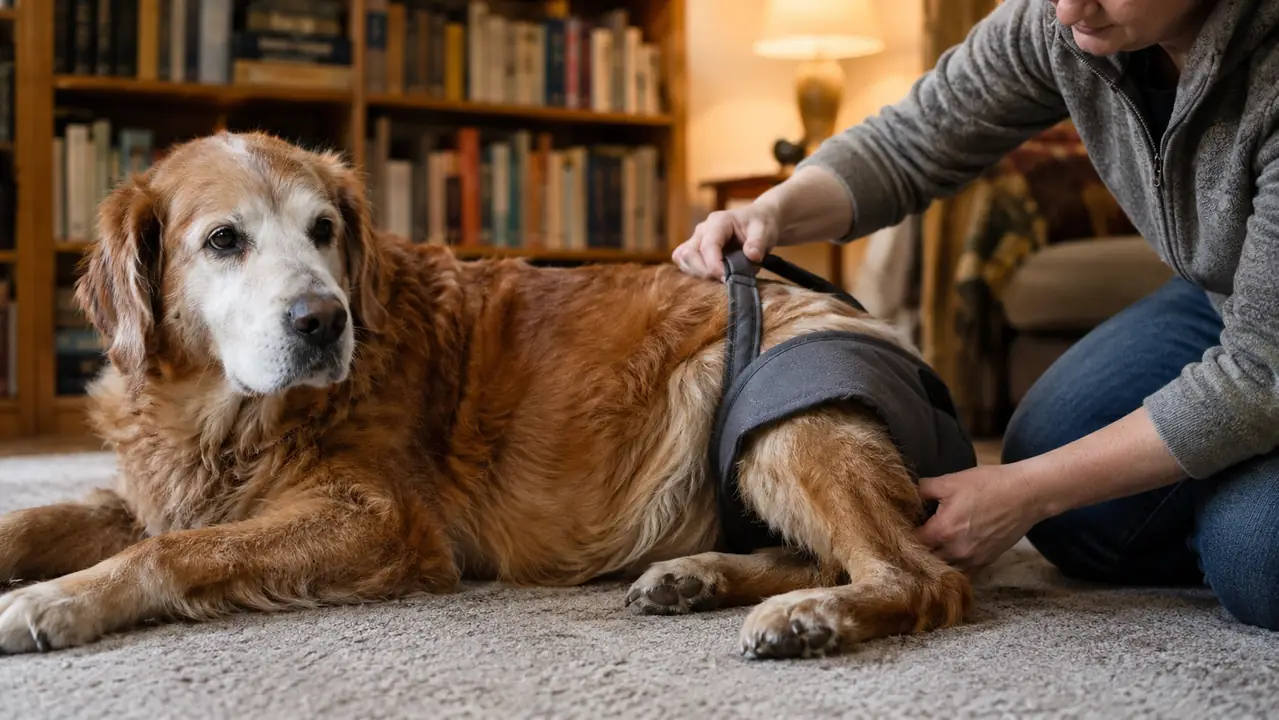
The PICK FOR LIFE listing is straightforward. Nylon shell, machine washable, drawstring closure, 14.08 ounces, package dimensions of 9.92 by 4.45 by 4.25 inches. The X-Large is cut for large to extra large dogs and the strap length is adjustable, which is the part that matters most for a deep-chested Lab. One caution: this is a rear-leg harness. There is no chest handle and no front lift, and if you order it expecting full-body support you will be disappointed with a product that is doing exactly what it was built to do.
That adjustable strap runs 52 to 76, which is a wide enough spread that the same harness will fit a Lab and a good deal more dog besides. I measured Ranger around the hindquarters with Linda's cloth tape before I ordered, then checked the number against that range, and the X-Large had room left over. Do that measuring at home with the dog standing square, not lying down, because a dog on his side always measures smaller than he really is. Fit it once, note where the strap lands, and you will get it right on the first try every morning after.
It carries 4.4 stars across more than 6,200 ratings on Amazon, which is a lot of buyers and a lot of opinions. When a listing has that many reviews I read the three-star ones, not the five-star ones, because the middle is where the truth lives. The complaints I saw came down to fit and expectations. The warranty note on the listing says seven days, which is thin, so treat the return window as your real safety net and try it on the dog the day it arrives.
What no spec sheet can tell you is how your dog will take to it. Ranger grumbled the first time and stood like a statue. By the third day he walked to the door when he saw it, because he had figured out it meant the steps would not hurt. Give it a minute at a time, with treats, before you decide anything.
What to Watch For
Fit first. Slide two fingers under the strap at the hindquarters. If you cannot, it is too tight, and you will find the rub line after a mile. Check behind the front legs and under the belly after every walk for the first week. Wash it when it needs it, since the nylon is machine washable, and let it air dry. And do not leave a harness on an unattended dog, especially one who likes to chew, because a strap is a strap.
There is one more piece of housekeeping nobody mentions. Watch how your dog lies down with it on. Ranger circles twice and flops, and the first week he flopped right onto the strap and lay there looking at me like I had done it to him on purpose. I started taking it off before he settled for the night and the grumbling stopped. Once a week it goes in the wash with the shop towels and comes out smelling like nothing much, which is how a dog ought to smell. Air dry it. Heat and nylon do not get along.
Second, be honest with yourself about what stage your dog is in. If he is hesitating on steps and slipping on smooth floors, a rear lift is the right tool and you will use it every day. If he is knuckling in front, or recovering from surgery on a front leg, or unable to rise without help at both ends, a rear sling will leave you short and you should be looking at a full-body harness. That is the whole decision, and it is worth getting right before you order.
Who Should Buy Which
Go with the PICK FOR LIFE harness if the problem is behind the ribcage. Your dog's back legs are weak, he is slow up the steps, he needs a hand into the truck, or he has slipped on a hard floor. You want something you can grab in a hurry with one hand, that your dog will tolerate, and that does not cost as much as the full-body option. For a dog like Ranger, that is the roof and the floor of it.
Go with the Help Em Up harness if your dog needs support at the chest as well as the hips, is coming through surgery, or needs to be lifted many times a day by someone who cannot hold a sling closed by hand. It costs more and it is fussier to put on, and for the right dog it is worth every bit of that. Talk to your vet about which one fits your dog's actual condition before you spend anything, and ask about weight and pain management too, because a harness is one part of a plan and not the plan itself.
One strap, two padded handles, and the porch steps stop being a negotiation
If your senior dog needs help with the back end and nothing else, the PICK FOR LIFE lift harness is the simple answer. Adjustable, machine washable, and light enough to keep in the truck.
Amazon See the Current Price on Amazon →