

Nobody tells you that a good dog slows down the way a good shortstop does. First he quits going to his right. Then he quits going altogether unless the ball is hit right at him. That was Ranger around age nine, and by the time our vet put a name on it, mild hip arthritis, I had already bought two tubs of joint chews that did nothing but make him picky about dinner. So when I say I came to VETIQ Hip and Joint Chews with a bad attitude, I mean it. I wanted the label to be honest, the results to be visible from the porch, and I did not much care which way it went. This is what happened over roughly four months, and what I would tell a friend at the fence line.
Understand what this is not. It is not a paid placement, it is not a cure, and it is not a review written by somebody who opened the tub on Tuesday and had strong feelings by Thursday. Ranger is eleven, a black Lab around eighty-two pounds, diagnosed at nine with mild hip arthritis. He has been on these chews since early spring. I paid for them the same way you would. What follows is the honest version: what the label says, what I actually saw, where it fell short, and who should keep their money in their pocket.
The Quick Verdict
A chicken-flavored soft chew with a real glucosamine dose and both krill and fish oil in the formula. Slow, and no help on a bad day, but by week six Ranger was getting off the floor easier and by week ten the porch steps stopped being a negotiation.
Amazon Check Today's Price →If your dog is hesitating on the steps, start the clock here
VETIQ Hip and Joint is a soft chew with 600 mg of glucosamine HCL, plus fish oil and krill, in a chicken flavor most Labs will take off your hand. It is not fast and it is not a painkiller. It is the thing I kept doing every morning for four months, and it worked.
Amazon Check Today's Price on Amazon →How I've Used It, Exactly
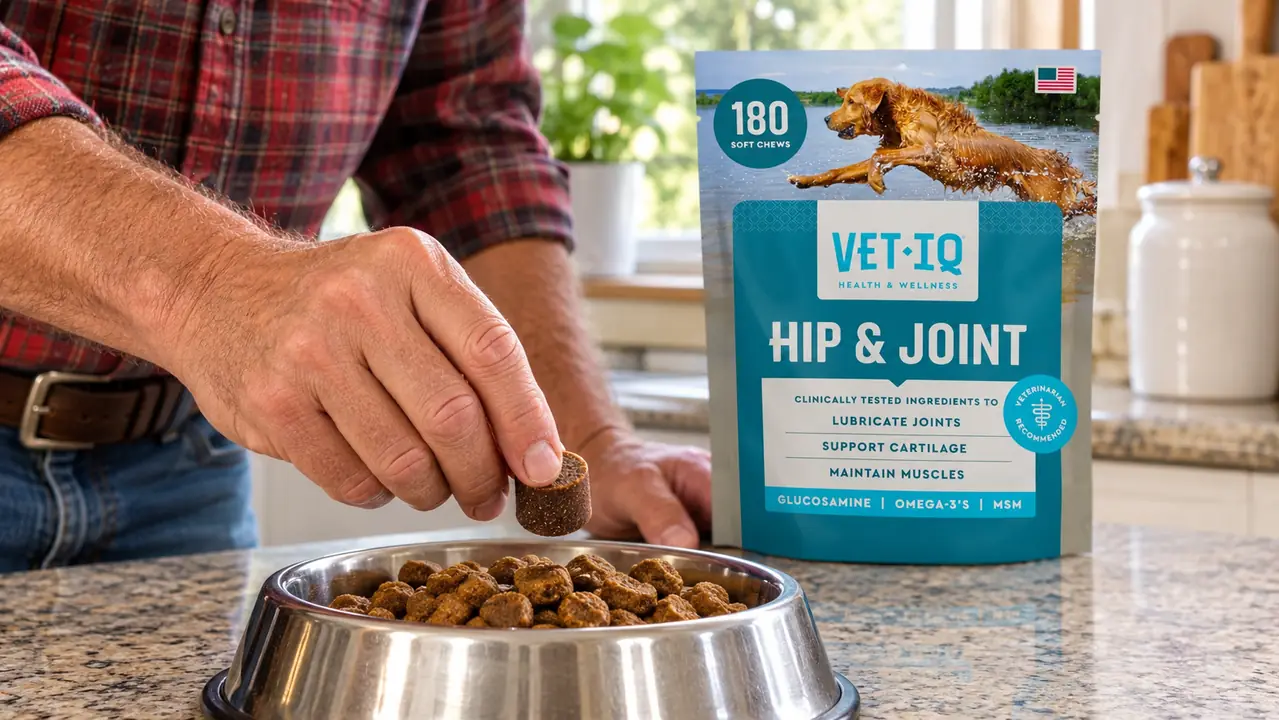
The tub holds 180 soft chews. At Ranger's weight the label put him at two a day, so a tub runs us a little over three months, which is long enough to actually know whether something is working. One goes on top of his kibble in the stainless bowl in the kitchen in the morning, and one goes down in the evening after the walk. He takes them whole with no coaxing. A Lab will take most things whole, so that is not much of a testimonial, but I have had chews he turned his nose up at and these he does not.
Before this tub there was a jar of soft chews from the feed store in town. Beef flavored, half the glucosamine, and Ranger ate exactly two of them before he started nosing them out of the bowl and leaving them on the floor like a man returning a bad casserole. Then I tried a powder you stir into the food. That lasted nine days. The powder clumped at the bottom of the bowl and he got to where he would look at the bowl, then look at me, and I do not need a dog to explain that twice. What I like about the VETIQ chews is that they are a discrete thing you set on top of the kibble, count in your hand, and know for certain went into the dog. When you are trying to decide whether something works, you cannot also be wondering whether he ate it.
The tub went on the counter next to the kibble bin and the lid comes off without a fight, which matters at 6:40 in the morning before the coffee is done. First morning I set one down and Ranger had it before the bowl hit the floor. I remember that specifically because it told me I would not be doing the thing owners do where they have to hide a pill in cheese and lie about it.
The first two weeks I saw nothing, and I want to be straight about that, because the honest answer to how long these take is longer than you want it to be. Weeks three and four I thought I might be seeing something, and I also knew I was looking for it, which is not the same thing as seeing it. Around week six Linda said, without my asking and without knowing I was watching for it, that he was getting up off the den carpet easier. That is the kind of evidence I trust. Nobody was trying to produce it.
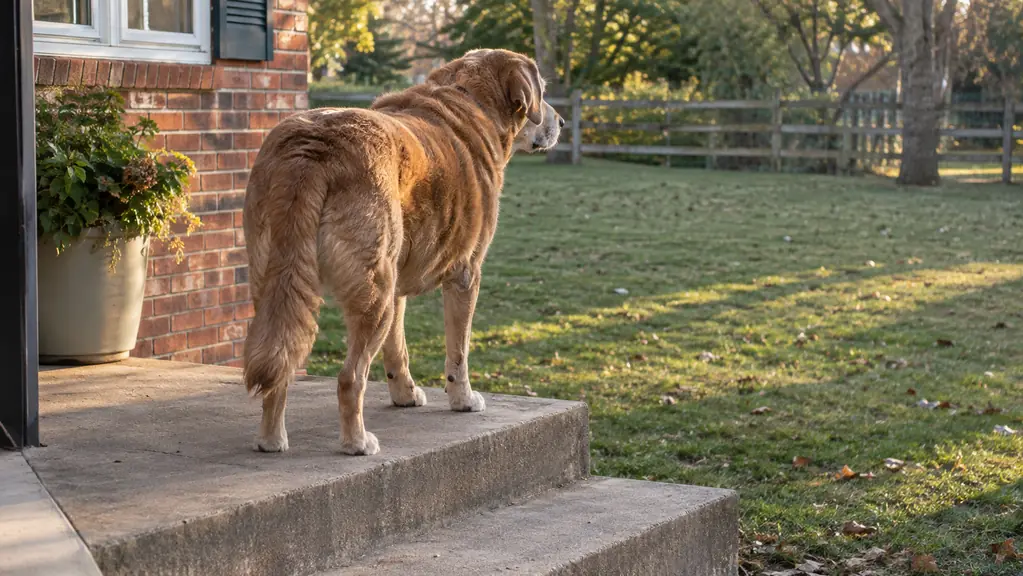
By week ten the change showed up in the porch steps. Two concrete steps down to the fenced yard, and for two years he had done this hop and pause on the way down, front feet first, back end gathering itself before it committed. He still goes down careful. He is eleven, not three. But he goes down without the pause. The twenty minute loop around the neighborhood has not gotten any longer. What changed is how he comes back from it and how quick he is to get off the kitchen floor afterward.
What Nobody Tells You About Joint Chews Before You Buy One
First thing, and this is the one that matters: a joint chew is not a pain pill. It does not work in an hour, and it does not rescue a bad day the way a prescription can. If your dog is yelping when he stands up, that is a conversation with your vet, not a purchase. What a chew like this does, when it does anything at all, is feed the machinery that keeps a joint from grinding on itself. That is slow work by nature. Anybody promising you overnight is selling you something else.
Second thing: consistency is the whole ballgame. I missed two mornings running in April, once for a church thing and once because I am seventy and forgot. He was stiffer by the third day. Could have been the weather. Could have been the gap. Either way, a chew you skip is a chew that does nothing, and if your week is chaotic enough that you cannot promise two a day, you are better off putting the money somewhere else. Half a routine does half a job and costs exactly the same.
Third: his weight is doing more work than the tub is. Our vet has been after me about Ranger's waistline since the diagnosis at nine, and she is right, and I know she is right because I have watched him move better after we trimmed him down. Eight pounds off an older Lab's frame takes load off the hips that no supplement on earth will take off. These chews helped. Keeping him lean helped more.
We did it the boring way, and I will tell you exactly what that looked like because it is the part nobody puts on a product page. We went from about ninety pounds down to roughly eighty-two over one winter using a measuring cup instead of a scoop out of the bin, and cutting the table scraps, which in this house means me not sliding him anything under the table when Linda is not looking. That was not fun for either of us. He is a Lab. He believes he is owed. But the difference in how he came up off the kitchen floor was visible before the chews ever entered the picture, and I would be lying if I let a tub of chicken chews take credit for it. If you buy the chews and keep filling the bowl, you have bought the expensive half of the solution and skipped the free half.
What's Actually in the Tub
Here is the label, plain. Glucosamine HCL at 600 mg, fish oil at 280 mg, krill at 210 mg, and MSM, which is right there in the product name next to the krill. Chicken flavor, soft chew form, 180 count, a tub about nine inches tall by seven wide and three deep, a little over a pound of product in it. That is a real glucosamine number, not a sprinkle for the label's sake. Plenty of chews on the shelf carry a token amount and a lot of confident packaging. This one carries a dose you can point at.
The back panel is dense, and I appreciated that more than I expected to. It lists the active ingredients by weight instead of burying them inside a proprietary blend, which is the trick a fair number of these products use so they never have to say how much of anything is actually in there. A proprietary blend is a polite way of saying trust us. I have been coaching long enough to know what that phrase is worth.
The krill is the part that got my attention, and it is why I picked this over a plain glucosamine tablet. Krill and fish oil are both in the formula, which means you are covering the omega side of the argument and the joint side in one chew instead of buying two separate products and remembering both. I am not a nutritionist. I am a retired coach who reads labels in the kitchen with his glasses pushed up on his head. But I have read enough of them to know what padding looks like, and this is not that.
Two things I will not pretend to know. I could not tell you the exact breakdown of every line on that panel, because the panel runs longer than what gets quoted on a product page and I am not going to invent a number to sound thorough. And I cannot tell you what is in the chicken flavoring beyond chicken. If your dog has a food sensitivity, read the tub in your own hand and call your vet before you start. That is not a dodge. It is the honest limit of what a man with a pickup truck ought to be telling you.
What I Liked
- 600 mg of glucosamine HCL per chew, a real dose and not label decoration
- Krill and fish oil both in the formula, so you are not buying a separate omega product
- Soft chew he takes whole out of the bowl with no coaxing
- 180 count tub runs a little over three months at two a day for a big dog
- Ingredients listed by weight instead of hidden in a proprietary blend
Where It Falls Short
- Slow. Six weeks before I would swear to anything, and that is a long time to keep paying attention
- Not a painkiller, no help on a bad day, no substitute for a vet visit
- Costs more per chew than a plain glucosamine tablet, and you are paying for convenience
- Strong chicken smell that stays on your fingers until you wash
- Not a small-dog product. Splitting a chew for a little dog is guesswork
Around week six he was getting up off the den carpet easier. By week ten the porch steps stopped being a negotiation.
The Parts That Annoyed Me
The smell. It is a chicken flavored soft chew and it smells like one, and after you have handled two of them your fingers smell like it until you get to the sink. Ranger does not mind a bit. My truck does. The VETIQ tub also takes up more counter space than I expected, roughly the footprint of a coffee can and taller than one, and it lives next to the kibble bin now because that is where the routine happens. Small complaints, all of them. But you asked for honest, and honest includes the counter space.
The counting gets old. Two a day, 180 in a tub, and I am the sort of person who wants to know exactly where he stands in the count. I ended up marking the lid with a pencil, which is not a thing I planned on doing at seventy years old. That was in April, after a Sunday where I genuinely could not remember whether the morning chew had gone down. Two a day is not complicated and I still lost track of one. The pencil fixed it. So did moving the tub next to the coffee can, because coffee happens every morning whether I am thinking about it or not, and the chew may as well ride along with it. If you have two dogs you will be doing arithmetic in your head. If you have one, you will still be doing arithmetic, just slower.
And the honest one: this is not cheap to run forever, so treat it as a standing decision and not a one-time one. If Ranger were three years old I would have a different answer about whether to start at all. At eleven, with a diagnosis on paper and a vet who wants to see him twice a year, I would rather spend it here than on a ramp he refuses to walk up. That is a judgment call. Your dog and your budget are not mine, and I am not going to pretend otherwise to make a sale.
What It Didn't Do
It did not make him a puppy. He still takes the porch steps one at a time, he still sleeps more than he did at eight, and he still picks the carpet over the vinyl plank in the hallway every single time. It did not fix the way he sits, which has been a little crooked since the diagnosis and which our vet says is structural, not nutritional. And it did not touch the cold wet mornings. Chews do not reach that kind of day, and anyone who tells you theirs does is either selling or lucky.
It also did not replace one thing the vet told us to do. She has him on a lean diet, she wants the loop kept at twenty minutes and no more, and she wants eyes on him twice a year. The chews are one line in that plan, not the plan. If what you are shopping for is the thing that lets you skip the rest of it, this is not it, and I would be doing you a disservice to let you think a soft chew with a chicken smell is going to cover for a dog that needs to see his vet.
Who This Is For
This is for the owner of an older dog who is stiff in the back end, who hesitates on steps or at the tailgate of a truck, who has a diagnosis or at least a vet's suspicion of one, and who is willing to hold a two a day routine for two months before deciding whether it did anything. It is for the person who wants the glucosamine number on the label to be a real number and who does not want to buy three separate products to cover the same ground. If that describes your house, VETIQ is a reasonable place to start and a fair thing to try.
Who Should Skip It
Skip it if your dog is in pain right now, because this is not that, and you will lose a month finding out the hard way. Skip it if you cannot be consistent, because a routine you half keep does half a job at full cost. Skip it if your dog is a picky eater, since a soft chew with a strong chicken smell is not a universal yes and a dog who turns his nose up will not be talked around by you or me. And skip it if your vet has not laid hands on your dog. Get the diagnosis first. Then decide what to buy, and decide it with somebody who has actually examined the animal.
Two chews a day for one full tub. That's the whole test.
No overnight promises here. A real glucosamine dose at 600 mg, krill and fish oil in the same chew, chicken flavor, 180 to a tub. Give it the full three months before you make up your mind, and give your vet a call before you start.
Amazon Check Today's Price on Amazon →