

Ranger is eleven years old, eighty-two pounds, and black as a wet tire. He is a Labrador, and he has the hip arthritis our vet found when he was nine. He does not whimper about it. He pauses. He gets his front legs up off the den carpet and then sits there a beat, working out the back end, before he stands up the rest of the way. If you have a big dog doing that pause, you already know the sound of it. It is quiet and it is loud at the same time.
I am not a veterinarian. I am a retired high school baseball coach, seventy years old, and I spent thirty years watching bodies move badly and figuring out what to do about it. So here is how I would coach this. Stiffness in a large dog is not one problem. It is four: the joint, the muscle around it, the floor under it, and the weight it is carrying. Cosequin from Nutramax Laboratories is the piece I use for the first one, and it is a piece, not the whole thing.
One thing first, and I mean it plainly. Talk to your vet before you start or change any supplement. That is not throat clearing. It is step one below, and it is the longest step.
The Joint Supplement I'd Start With
Cosequin Maximum Strength is the chewable tablet that lives next to our coffee maker. Glucosamine, chondroitin, MSM, and hyaluronic acid in one tablet, 75 to a bottle. Check today's price and the current bottle size before you decide.
Amazon Check Today's Price on Amazon →Step 1: Have the Vet Put Hands on the Dog Before You Buy Anything
The temptation with a stiff dog is to order something the same afternoon and hope. I have done that with a truck part and I have done it with a dog. What I would do instead is book the exam first. Hip arthritis is one of several things that make a big dog slow to rise, and the plan for a soft tissue strain is not the plan for a joint that has lost cartilage. You want a professional opinion before you spend a dime or a month.
Our vet ran a range-of-motion check on Ranger's back hips, watched him walk away from him and back, and ran his hands down the spine. Then he said two things I still use: mild hip arthritis, and a couple of pounds to lose. I would not have gotten either one from a product page. He also asked what Ranger was already taking, which is the other reason to go in.
Bring a thirty-second video of your dog getting up from a nap. It beats trying to describe it in the exam room, and it gives the vet something to compare against in three months. Then get the answers written down, not nodded at: what the diagnosis is, what the weight target is, what you should add, and what you should not add.
That last part matters more than people think. If your dog is on a prescription anti-inflammatory, you want the vet to sign off on anything you put in the bowl alongside it. Ranger is not on one, but I asked anyway, and I asked whether the answer would change if the arthritis got worse. Getting that on the record in year one saved me a phone call in year three.
Step 2: Get the Tablet Count Right for the Dog You Actually Have
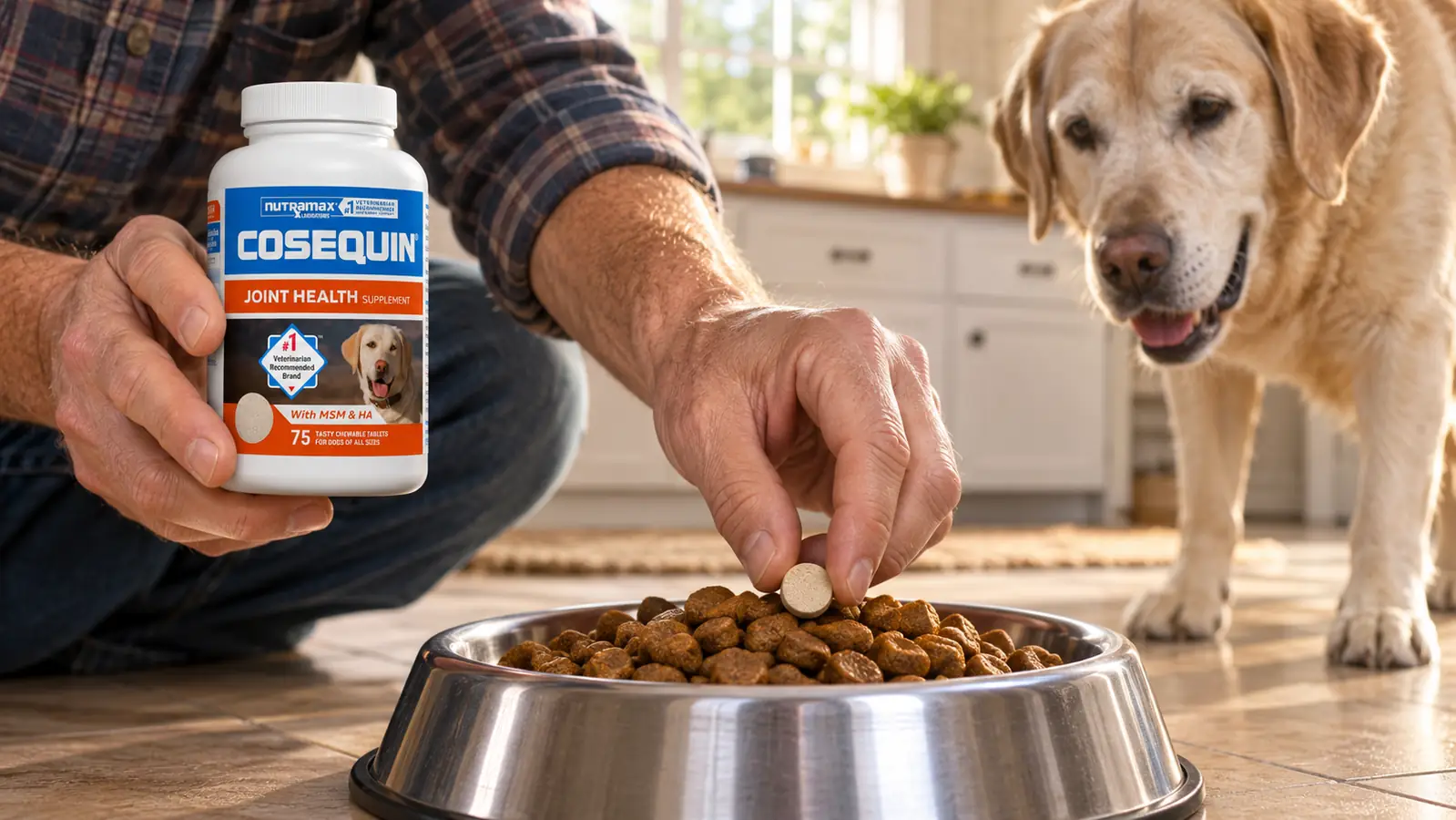
Cosequin Maximum Strength comes as a chewable tablet, and the label lists what is in it: glucosamine hydrochloride at 600 mg, sodium chondroitin sulfate at 300 mg, and MSM, along with hyaluronic acid. Those are the numbers that make the tablet count matter. A large dog does not mean give him whatever is left in the bottle. It means the count your vet sets for his weight, written down.
Ranger is eighty-two pounds. I asked the vet for the count out loud, wrote it on an index card, and taped the card inside the cabinet door above the counter where the bottle lives. Then I asked whether the number changes after the first few weeks. I would rather hear that from a man in a white coat than squint at a chart in bad kitchen light and guess on a Tuesday.
Here is the arithmetic nobody does. The bottle we buy holds 75 chewable tablets. Divide that by your dog's daily count before you decide one bottle is a month's supply. For a big dog it may not be, and running out on a Saturday morning is exactly how a good routine dies. I buy two at a time now for that reason and no other.
One practical note on giving it. Ranger takes his tablet in the kibble with a splash of warm water, no argument. Some dogs will take it dry out of the hand and some will turn their nose up, and if yours is the second kind, ask the vet before you start wrapping it in cheese or lunch meat. The cheese can undo the weight work faster than the tablet helps the hip.
Step 3: Same Time, Same Bowl, Every Single Day
A supplement is not a drill you run once and grade. It is a habit, and habits need a hook. Ranger's hook is the morning. He goes out, he comes back in, he gets his tablet in the bowl, and then I get my coffee. Same order, every day, including the days I am running late for church.
It is in the same five-minute window every morning because I do not have to remember it that way. That is the whole trick. If the tablet depends on me being organized, it gets skipped, and the skipped days are the ones that add up to a lost month you cannot explain later.
Linda will tell you I am a creature of routine to a fault. She is right, and this is one place where it pays. The dog does not know what day it is, but he knows the sound of the bottle. By week two he was standing by the bowl before I got there, which is either loyalty or math. Either way, he does not miss a dose.
Step 4: Fix the Floor and the Two Steps Before You Blame the Pills
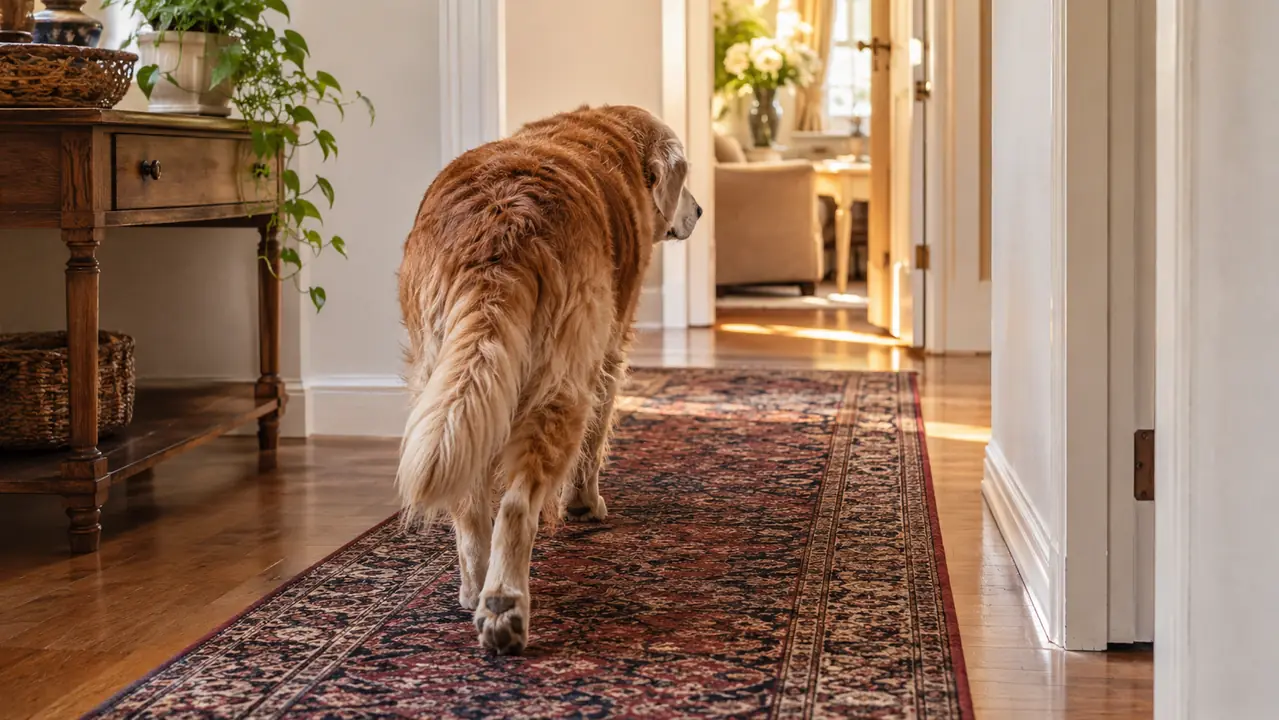
This is the part nobody sells you. Ranger's worst mornings are not on the den carpet. They are on the vinyl plank in the kitchen and the hallway, where a big dog's feet slide out from under him and he has to scramble to stay upright. Scrambling is what teaches a dog to hesitate. Fix the floor and you change the hesitation, with or without a supplement.
We put a runner down the hallway and a cheap rug at the kitchen sink. At the back porch, those two concrete steps down to the fenced yard are his slowest thirty seconds of the day, so I go down first and let him follow at his own pace instead of hustling him. When he was nine he started hesitating before the jump into the F-150, so there is a ramp behind the seat now.
Two more items, both free. Keep the nails short, because a long nail changes how a big dog's foot lands and he will feel it up the leg. And watch the weight. Our vet's short version was that a few pounds off a Labrador does more than anything he could hand me, and I have not found a reason to doubt him yet.
Step 5: Write It Down and Judge It at Thirty Days, Not Three
You will not remember how he was three weeks ago. I say that as a man who swore he would. Memory is a liar when it wants a result. So get a cheap notebook and write four things each morning: the date, how long it took him to stand up, whether he hesitated on the porch steps, and how far you walked. Four lines. It takes a minute.
The camera on your phone is better than the notebook. Same spot in the driveway, same time of morning, one short video every two weeks. When you have four of them side by side you will see things the eye forgives in real time, in both directions. That is the honest version of thinking he seems better.
Thirty days is a fair look at a joint supplement. Three days is not. Cosequin is not a painkiller and it will not behave like one, so do not expect a stiff dog to trot out of the gate by Thursday. What you are watching for is a shorter pause, a straighter walk, a dog who gets up on the first try more often than he did a month ago.
Give it a full sixty days before you quit on it, and quit on it in the right order. If the notebook says nothing changed, call the vet before you call the brand a dud, because the answer might be the tablet count, the weight, or something the supplement was never going to touch. That is not a knock on the product. That is how joints work.
That is the report from this house. Ranger still pauses. He is eleven. But the pause is shorter, and the twenty-minute loop around the neighborhood takes about what it used to instead of running long. That is my read on my own dog and nothing more. Your dog is not my dog, which is why the vet and the notebook come before my opinion.
Cosequin did not make Ranger young again. It made the morning pause shorter, and around here that is the whole ballgame.
What Else Helps
Weight first, always. Every extra pound a big dog carries lands on the same two hips that are already unhappy. Cut the table scraps, measure the kibble with a real cup instead of a coffee can, and give it eight weeks before you judge it. Second, two shorter walks beat one long one. A slow twenty minutes in the morning and a slow twenty at dusk keeps a stiff dog moving without turning him sore. Warm up the first five minutes at a shuffle, same as you would a pitcher.
Third, bedding. Ranger sleeps on a thick pad in the den now, not the bare carpet, and the difference in how he rises at six in the morning is not subtle. Fourth, ask the vet about the rest of the plan: prescription options if the arthritis advances, and whether a fish oil or a weight-focused food makes sense alongside the Cosequin. I am not going to talk you out of asking a professional a question.
Fifth, read before you buy. I wrote up our six months on this bottle in [our long-term Cosequin review](/cosequin-review-long-term), the case for [glucosamine and chondroitin in senior dogs](/10-reasons-glucosamine-chondroitin-helps-senior-dogs) is laid out there in plain terms, and if you are weighing brands, [Cosequin against Zesty Paws](/cosequin-vs-zesty-paws-glucosamine) is the comparison I would start with. Nutramax Laboratories makes the one our vet named first, and after two years that is still where we landed.
Start the Thirty-Day Log With the Bottle Our Vet Named
Cosequin Maximum Strength, 75 chewable tablets, from the brand Nutramax Laboratories has been building for over 25 years. Get the bottle, get the vet's count on a card, and give it a fair month.
Amazon Check Today's Price on Amazon →