
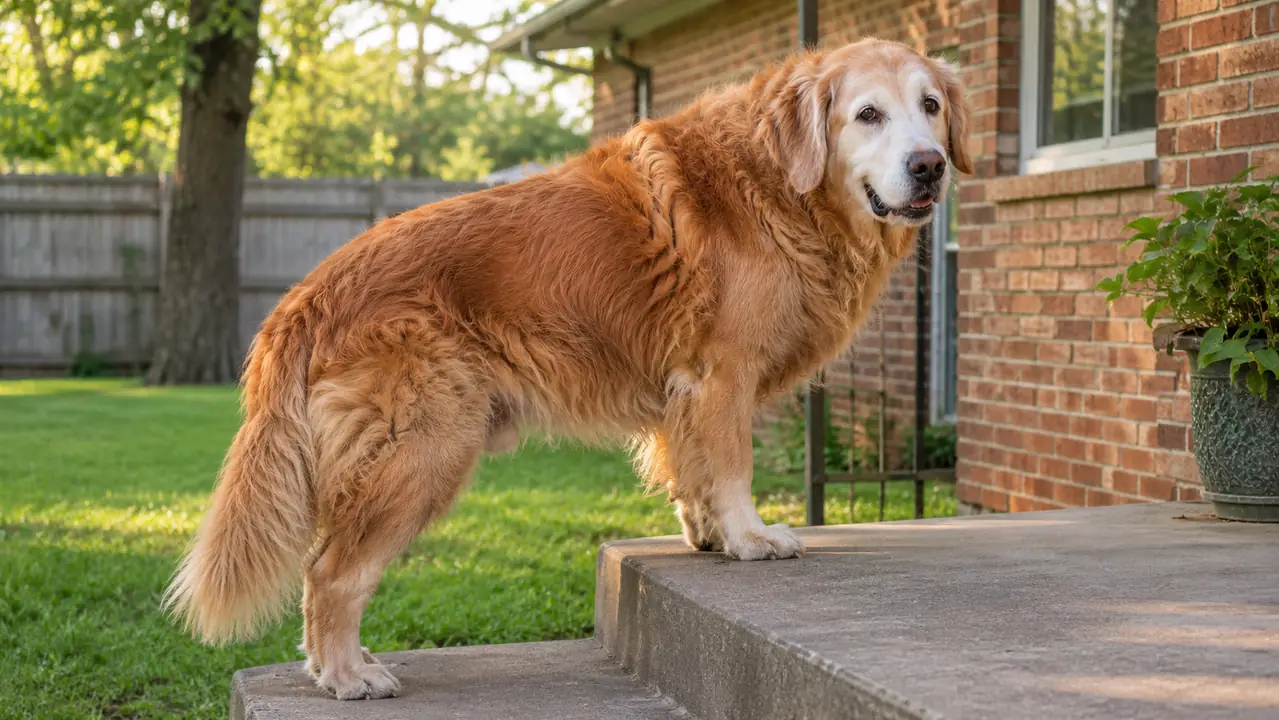
Ranger is eleven now, a black Lab who weighed 82 pounds at his last checkup, and for most of his life he took the two concrete steps off my back porch at a trot. Last spring he started stopping at the top of them. Not sitting. Just stopping, front feet on the top edge, back feet still on the step below, working it out. Linda and I would stand in the kitchen and watch him decide. Some mornings he went. Some mornings he turned around and went back to his bed.
If you are reading this, you have probably got a dog doing the same arithmetic. Maybe it is the porch. Maybe it is the three steps up to the front door, or the tailgate of the truck, or the stairs to a second floor you have quietly started avoiding. You have tried the towel under the belly, which works for about four seconds and ruins your back. You have looked at ramps, which slide on concrete and scare a stiff dog worse than the stairs did. What finally got Ranger moving again was a rear lift sling: the PICK FOR LIFE Adjustable Dog Lift Harness, X-Large, which is the size for large to extra large dogs. It has more than 6,200 ratings on Amazon at 4.4 stars, so it is not some novelty someone drew on a napkin.
What follows is how I would explain it if you were standing in my driveway. Five steps, in order. None of them are hard. But doing them out of order is how people end up with a dog that fights the harness, or a handler with a sore shoulder, or both. Give it a week. It is worth a week.
The right size for an 82-pound dog, not a 20-pound one
The X-Large adjusts across a 52 to 76 range and puts 14 ounces on the dog, not on your back. Padded handles, nylon sling, machine washable, and built for the rear end of a big dog who needs a hand for thirty seconds.
Amazon Check Today's Price on Amazon →What a Rear Lift Sling Actually Does
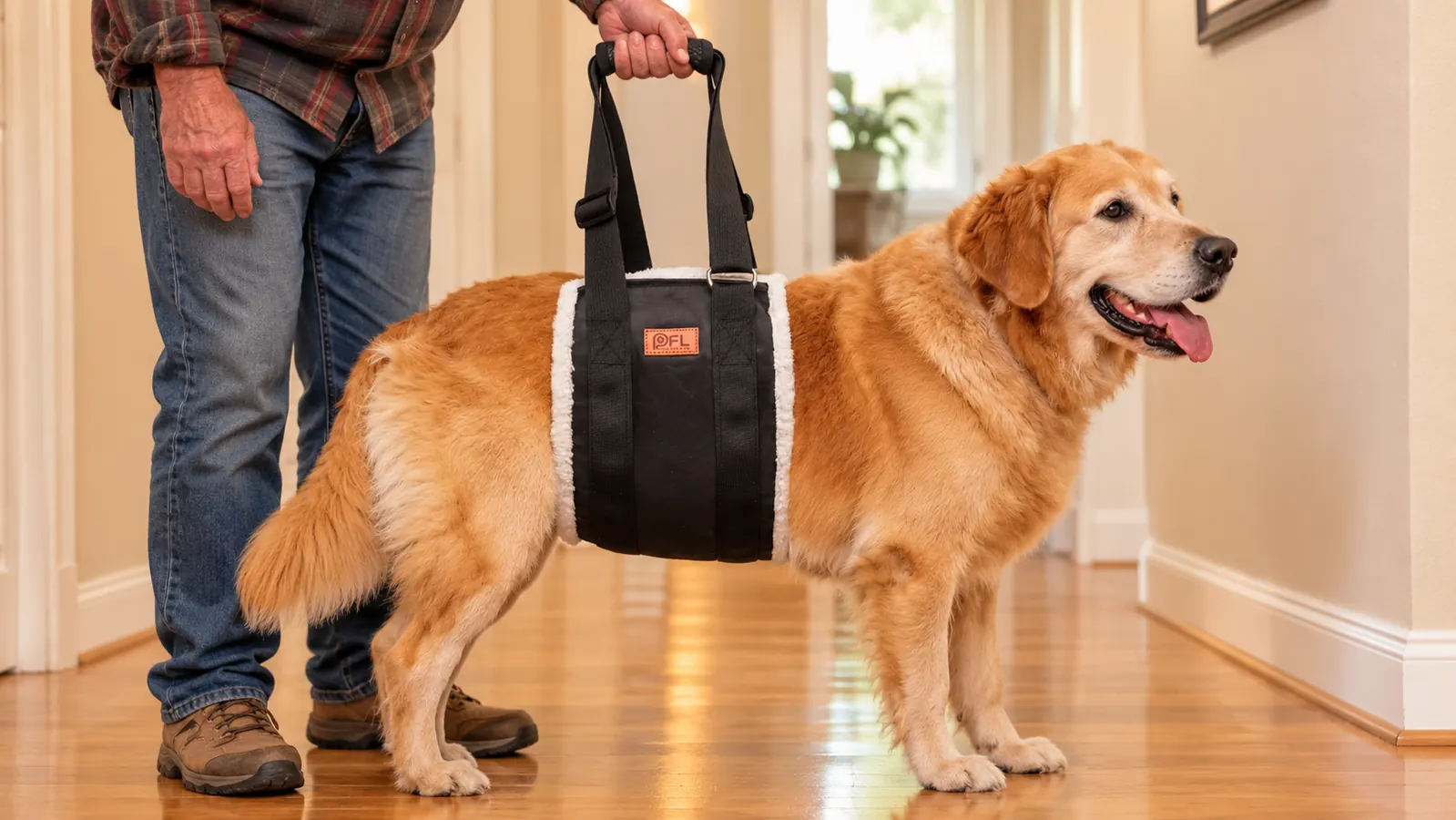
The name undersells it. It is a nylon sling that passes under the dog's rear end, with an adjustable strap and padded handles that come up near your hip. You hold a handle. You do not lift the dog. You take some of the weight off the back legs for the seconds it takes to get up the steps, then you let go and let him walk.
Two things matter about that. First, the dog keeps using his own legs, which is the whole point with arthritis. A dog that gets carried loses strength fast, and a weak dog is a dog that falls. Second, your back survives. I am seventy years old with two shoulder injections to my name. I cannot carry 82 pounds of Labrador up a step, and I should not try.
Step 1: Fit the Strap Before You Go Near a Stair
Do this in the kitchen with the dog standing square. Set the strap so the handles land near your hip with your arm hanging mostly straight down. If the handles sit at your knees, you will be hunched over the whole way up. If they sit at your chest, you will be lifting instead of supporting, and your shoulder will tell you about it the next morning. The adjustment on the PICK FOR LIFE harness runs from 52 to 76, so there is plenty of room in it to find that spot.
Then check two other things. The sling should sit under the rear end, not up over the hips like a walking harness, and it should not be digging into the flanks. Snug is right. Tight is not. Ranger is a broad dog and I had to open the strap two notches past where I first set it, so do not be surprised if your first guess is wrong.
Do all of this with the stairs out of the picture entirely. Nothing about the first fitting should happen near a step. You want the dog standing relaxed in a room he likes, not bracing at the top of a staircase wondering what you are up to.
Step 2: Put It On a Standing Dog
A dog lying down is dead weight and a bad attitude. Get him up first, even if that means a piece of chicken held at nose height and some patience. Then slide the sling under the rear from the side, bring the strap up, and set the closure. The PICK FOR LIFE harness uses a drawstring closure, which takes me about fifteen seconds now. It took me about a minute the first time, with my reading glasses on.
Talk while you do it. I know that sounds soft, but a dog reads your tone before he reads anything else. Ranger's ears went back the first time I slid the sling under him, so I stopped, scratched his chest, and started over. Second attempt he stood still like he had been doing it for years.
Then take it right back off. That is it for day one. On and off, twice, with a reward each time. You are teaching a small, boring habit, not staging a rescue.
Step 3: Dry Runs on Flat Ground
This is the step people skip, and it is the one that decides whether any of the rest works. Harness on. Walk the dog around the house with your hand on the handle but no weight in it. Kitchen, hallway, den. Ten minutes, two or three times a day, for two or three days.
Why bother. Because a dog that has only ever felt the harness at the bottom of a staircase learns to hate the staircase. A dog that has felt it on a Tuesday morning in the kitchen learns that it is just a thing that happens to him now and then, like the mailman.
By the third day I could rest a little weight in my hand on the vinyl plank in the hallway and Ranger did not break stride. That was my signal to move to the steps. Not a calendar date. The dog tells you.
One caution. If your dog tucks his tail or tries to bite the strap, stop and go back to on and off with no walking. That is fear, and fear needs a few more days, not a firmer hand.
Step 4: Take the Steps One at a Time
Position yourself on the dog's right side, slightly behind the shoulder, hand on the handle, arm relaxed. You want to be beside the hip, not out in front pulling him. Let the dog choose the pace and the foot. Your job is to keep the rear end from swinging out and to take the sag when a back leg quits halfway up.
One step, stop, praise. Then the next one. My back porch has two steps and it took us a full minute to do them the first time. Do not count steps and do not rush for the top. A dog that scrambles is a scared dog, and scared is how you get a fall on concrete.
Going down is harder than going up, and that surprised me. On the descent the back legs have to brake, and Ranger wanted to launch himself off the top step like a much younger dog. I go first now, so he is following my shoulder down instead of diving past me. The handle stays firm the whole way.
Leave the truck tailgate for week two. A tailgate is a step up and a jump down, and the jump down is the part that hurts. Get the porch and the front steps boring first.
The first trip up, I took maybe fifteen percent of his weight. Three weeks later it was closer to half. You are not carrying the dog. You are taking the wobble out.
Step 5: Build the Routine, Then Give Some of It Back
Use the harness for the trips that are actually hard, and let the dog handle the flat ground himself. Ranger wears it for the porch steps in the morning, for the yard when the grass is wet, and for the truck. He does not wear it in the den. The point is to keep the muscle he still has, not to make him a passenger in his own life.
Watch the day after. If he is stiffer twenty-four hours later than he was before, you did too much and you should cut back. If he is the same or looser, you are in the right range. I keep a note on the refrigerator door, one line a day, because I cannot remember Tuesday by Thursday and neither can you.
And call your vet before you build any program around this. Ours is the one who told me a sling is a tool and not a treatment. It buys a dog a way to keep moving while whatever else you are doing, medication, weight loss, a joint supplement, has time to work. It does not fix arthritis. Nothing fixes arthritis. It just gets Ranger up the steps, and up the steps is where the day starts.
What Else Helps
Trim the toenails. A stiff dog with long nails on a hard floor is a dog on ice skates. This is the cheapest item on the list and the one people forget, and our vet tech will do it in ten minutes if you would rather not.
Get some mats down. My kitchen and hallway are vinyl plank, which is slick as a boat deck when a Lab is trying to turn his back end around on it. Two rubber-backed runners did more for that dog than the harness did, honestly. The den is carpet, and Ranger chooses the carpet every single time he gets a vote.
Watch the weight. Every extra pound on an 82-pound dog with hip arthritis is a pound the back legs carry up every step, every day. Our vet gave us a target number and we weigh him on the same scale on the first of the month.
And go shorter, more often. Twenty minutes around the neighborhood loop is our number now, and it is slower than it used to be. Two ten-minute walks beat one twenty-minute walk when the hips are sore. Warm him up on flat ground before you ask him for the stairs, the same way I would not have sent a kid into a drill cold.
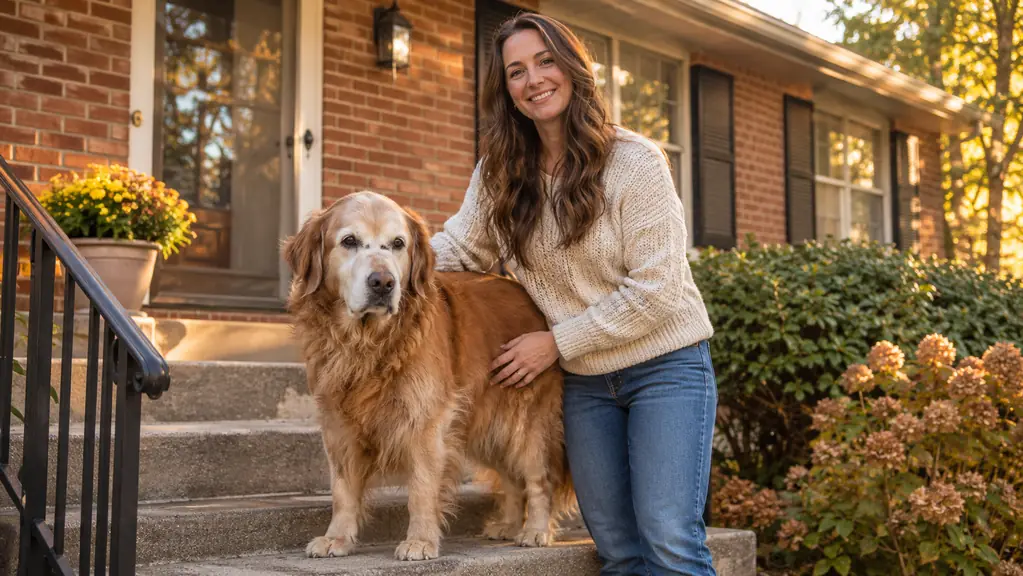
Mistakes I Made So You Don't Have To
I tried the towel first. It cut into my hands, it slipped out from under him twice, and Ranger hated the feel of it against his belly. There is a reason a purpose-made sling has padded handles. That is not marketing. That is your fingers.
I also went too fast. On day two I took him up the porch steps and he balked at the top with his back feet still on the bottom step. We went back to flat ground for three more days and it never happened again. Slow is fast with a scared animal. I used to say that about freshmen learning to hit a curveball, and it turns out it applies to dogs.
Who This Is For, and Who It Isn't
This is for the owner of a big dog who is still walking but hesitating, the one who stands at the bottom of the steps and thinks about it. Weak rear legs, arthritis, recovery from surgery, a dog who needs help for thirty seconds and then wants to be left alone. If that is you, the X-Large PICK FOR LIFE sling is a sensible first purchase and it costs less than one vet visit.
It is not for a dog who cannot bear weight at all, or who has gone down in the back end and stayed down. That dog needs a call to the vet today, not a sling from the internet. And it is not a substitute for the harder work: the weight, the nails, the mats, the shorter walks, the medication your vet recommends. The harness is one tool in a small kit. It just happens to be the one that gets you both off the porch.
Two porch steps shouldn't be the end of the morning walk
The X-Large adjusts from 52 to 76, adds 14 ounces to the dog, and goes in the washing machine when the yard is muddy. If your dog is stopping at the top of the steps and thinking about it, this is the simplest way to keep him going up them.
Amazon Check Today's Price on Amazon →